



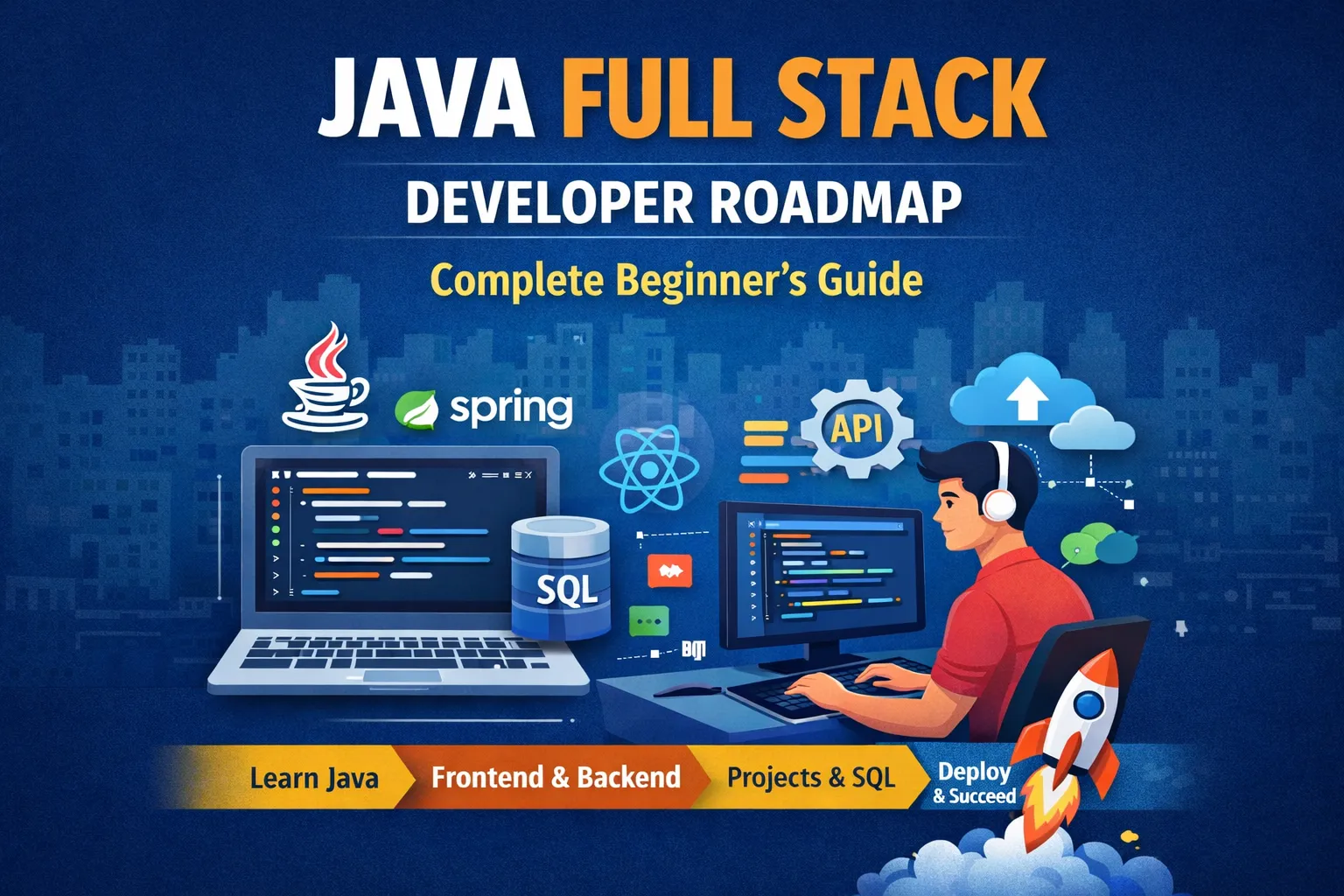
The demand for full stack developers is growing rapidly in 2026. Companies prefer professionals who can handle both frontend and backend development. If you want to build a successful career in web development, following a structured Java Full Stack Developer Roadmap is the smartest approach.
In this guide, we will cover everything you need to know to start your journey — from Java fundamentals to backend frameworks, frontend skills, databases, and DevOps basics.
Introduction:
Java full stack development refers to building complete web applications using Java technologies for backend development and modern frontend tools for user interfaces. A professional following the Java Full Stack Developer Roadmap learns how to design, develop, test, and deploy full-fledged web applications.
Java is one of the most powerful and widely used programming languages in enterprise-level applications. It is platform-independent, secure, and highly scalable. When combined with frontend technologies like HTML, CSS, JavaScript, and frameworks like React or Angular, Java becomes a complete full stack solution.
Full stack development means you can work on:
- Client-side (frontend)
- Server-side (backend)
- Database
- Deployment
Learning Java full stack development opens opportunities in startups, MNCs, and product-based companies. It also provides strong career growth and attractive salary packages.
Who is a Java Full Stack Developer? Roles & Responsibilities
A Java full stack developer is a software professional who works on both frontend and backend parts of web applications using Java technologies. Following the proper Java Full Stack Developer Roadmap helps you understand how to manage complete application architecture.
Key Responsibilities:
- Designing responsive user interfaces
- Developing backend logic using Java & Spring Boot
- Managing databases like MySQL or MongoDB
- Building REST APIs
- Integrating frontend with backend
- Testing and debugging applications
- Deploying applications to cloud platforms
Unlike backend-only or frontend-only developers, full stack developers understand the entire development lifecycle. Companies value them because they can independently handle projects and reduce dependency on multiple teams.
In short, a Java full stack developer is a complete web solution builder.
Why Choose a Career as a Java Full Stack Developer in 2026?
The tech industry is evolving rapidly, and companies demand versatile developers. Following a structured Java Full Stack Developer Roadmap in 2026 offers massive career advantages.
Reasons to Choose This Career:
- High Demand – Java remains one of the top enterprise languages.
- Attractive Salaries – Full stack developers earn higher than single-stack developers.
- Career Flexibility – Work in startups, MNCs, or freelance.
- Global Opportunities – Java is used worldwide.
- Strong Community Support – Large developer ecosystem.
Many companies still rely on Java for banking, fintech, healthcare, and enterprise software systems. Spring Boot and microservices architecture further increase demand for Java full stack developers.
If you want job security, stability, and long-term career growth, this is a smart career choice.
Prerequisites to Start the Java Full Stack Developer Roadmap
Before diving deep into the Java Full Stack Developer Roadmap, beginners should understand some basic prerequisites. You don’t need a computer science degree, but having foundational knowledge helps.
Basic Requirements:
- Understanding of basic computer operations
- Logical thinking and problem-solving skills
- Basic knowledge of programming concepts
- Familiarity with the internet and browsers
If you are completely new, start with:
- Basic programming logic
- Flowcharts
- Algorithms
- Data structures fundamentals
Consistency is more important than background. Even non-IT students can become Java full stack developers with disciplined learning.
Also, make sure you have:
- A laptop with at least 8GB RAM
- Stable internet connection
- Code editor (like VS Code or IntelliJ)
Once these basics are ready, you can confidently start your roadmap.
Step 1: Learn Core Java Fundamentals
The first and most important step in the Java Full Stack Developer Roadmap is mastering Core Java. Without strong fundamentals, advanced frameworks will be difficult.
Key Core Java Topics:
- Data Types & Variables
- Operators
- Conditional Statements (if-else, switch)
- Loops (for, while, do-while)
- Object-Oriented Programming (OOP)
- Arrays & Strings
- Collections Framework
- Exception Handling
- Multithreading Basics
Understanding OOP concepts like:
- Encapsulation
- Inheritance
- Polymorphism
- Abstraction
is critical because Java backend frameworks heavily rely on them.
Spend at least 1–2 months strengthening Java fundamentals. Practice coding daily using platforms like LeetCode or HackerRank. Build small console-based projects such as a student management system or banking application.
Strong Core Java skills build a solid foundation for your entire career.
Step 2: Master Advanced Java & Backend Development
Once Core Java is strong, the next stage of the Java Full Stack Developer Roadmap is backend development.
Backend development focuses on business logic, APIs, and database connectivity.
Important Technologies:
- JDBC (Java Database Connectivity)
- Servlets & JSP
- Spring Framework
- Spring Boot
- Hibernate
- JPA
- RESTful APIs
Spring Boot is especially important because most modern companies use it for building scalable applications. It simplifies configuration and reduces boilerplate code.
You should learn:
- Dependency Injection
- MVC Architecture
- Microservices basics
- API creation & testing
Build projects like:
- Employee Management System
- REST API for E-commerce
- Blog Application Backend
Backend development is where Java truly shines. Mastering Spring Boot significantly increases your employability.
Step 3: Frontend Development Skills for Java Full Stack Developers
Frontend development is equally important in the Java Full Stack Developer Roadmap. Without frontend skills, you cannot build complete web applications.
Must-Learn Frontend Technologies:
- HTML5
- CSS3
- JavaScript
- Bootstrap
- React.js or Angular
HTML structures the webpage, CSS styles it, and JavaScript makes it interactive.
After learning basic frontend skills, move to modern frameworks like React or Angular. These frameworks allow you to build dynamic, fast, and responsive web applications.
Key frontend concepts:
- DOM Manipulation
- API Integration using Fetch/Axios
- Responsive Design
- State Management
Build projects like:
- Portfolio Website
- To-Do List App
- Weather App using API
Combining frontend with backend APIs makes you a complete developer.
Step 4: Database Management
Database knowledge is a crucial part of the Java Full Stack Developer Roadmap because every application needs data storage.
Popular Databases:
- MySQL
- PostgreSQL
- MongoDB
You must understand:
- SQL queries (SELECT, INSERT, UPDATE, DELETE)
- Joins
- Indexing
- Relationships
- Normalization
Relational databases like MySQL are widely used in enterprise applications. MongoDB (NoSQL) is useful for flexible schema-based applications.
Learn how to:
- Connect database with Spring Boot
- Perform CRUD operations
- Handle transactions
- Optimize queries
Practice building database-driven applications such as a login system or inventory management system.
A strong understanding of databases improves backend performance and scalability.
Step 5: Version Control & DevOps Basics
The final stage covered in this section of the Java Full Stack Developer Roadmap is learning version control and DevOps basics.
Essential Tools:
- Git
- GitHub
- Maven
- Gradle
- CI/CD basics
- Docker fundamentals
Git helps you track code changes and collaborate with teams. GitHub allows you to showcase your projects to employers.
Maven and Gradle manage dependencies in Java projects. Understanding build tools is essential for real-world development.
Basic DevOps knowledge includes:
- Continuous Integration
- Continuous Deployment
- Containerization with Docker
You don’t need to become a DevOps expert, but basic knowledge gives you a competitive edge in job interviews.
Here is the continuation of your SEO-optimized blog content (Points 10–18) for the primary keyword Java Full Stack Developer Roadmap.
Each section contains 100+ words and is written to maintain SEO density and readability.
Step 6: Build Real-World Projects
One of the most important stages in the Java Full Stack Developer Roadmap is building real-world projects. Learning theory is not enough. Recruiters and companies want to see practical implementation skills.
Projects help you:
- Apply frontend and backend knowledge
- Understand real-world problem solving
- Gain confidence in coding
- Build a strong portfolio
Project Ideas:
- CRUD Application using Spring Boot & MySQL
- Authentication System with JWT
- E-commerce Web Application
- Blog Management System
- Online Banking System
While building projects, focus on clean code, proper folder structure, and API integration. Upload your projects on GitHub with proper documentation.
Real-world projects prove that you can build end-to-end applications, which is the ultimate goal of the Java Full Stack Developer Roadmap.
Step 7: Testing & Debugging Skills
Testing is a critical yet often ignored part of the Java Full Stack Developer Roadmap. Writing code is not enough — ensuring that it works correctly is equally important.
Important Testing Tools:
- JUnit
- Mockito
- Postman
- Selenium
JUnit is used for unit testing Java applications. Mockito helps in mocking objects during testing. Postman is widely used for testing REST APIs. Selenium is helpful for automation testing of web applications.
Testing ensures:
- Bug-free applications
- Better performance
- Higher reliability
- Professional coding standards
Understanding debugging techniques using IDE tools like IntelliJ or Eclipse also improves your efficiency. Developers who write testable and reliable code are always preferred by companies.
Testing skills make you a more professional and job-ready developer.
Step 8: Deployment & Cloud Basics
After development and testing, the next step in the Java Full Stack Developer Roadmap is deployment. You must know how to make your application live for users.
Key Deployment Platforms:
- AWS (Amazon Web Services)
- Heroku
- Netlify (for frontend)
- Vercel
Learn how to:
- Package Spring Boot applications
- Deploy JAR/WAR files
- Configure environment variables
- Connect cloud databases
Basic understanding of cloud concepts like:
- Servers
- Load balancing
- Storage
- Security groups
is highly beneficial.
AWS is widely used in enterprises, so learning EC2 and S3 basics adds value to your resume. Deployment knowledge shows that you can manage applications beyond development.
Java Full Stack Developer Roadmap (Step-by-Step Timeline for Beginners)
Many beginners feel confused about how long it takes to complete the Java Full Stack Developer Roadmap. A structured timeline helps maintain consistency.
Suggested Timeline:
Months 1–2:
Learn Core Java & OOP Concepts
Months 3–4:
Learn JDBC, Servlets, Spring, Spring Boot
Month 5:
Frontend (HTML, CSS, JavaScript, React/Angular)
Month 6:
Database & Integration
Month 7:
Build 2–3 Full Stack Projects
Month 8:
Learn Git, Deployment, and Testing
Within 8–9 months of consistent effort, you can become job-ready. If you dedicate 4–5 hours daily, you may complete it even faster.
Consistency is the key to success in this roadmap.
Certifications to Boost Your Java Full Stack Career
Certifications are not mandatory, but they can strengthen your credibility while following the Java Full Stack Developer Roadmap.
Popular Certifications:
- Oracle Certified Java Programmer (OCP)
- Spring Professional Certification
- AWS Cloud Practitioner
Certifications help:
- Validate your knowledge
- Increase resume weight
- Improve job opportunities
- Boost salary potential
However, remember that skills matter more than certificates. Focus first on practical implementation and projects. Certifications should support your skills, not replace them.
A combination of strong projects + certification can significantly increase interview calls.
Salary, Job Opportunities & Career Growth
One of the biggest reasons to follow the Java Full Stack Developer Roadmap is the excellent salary and career growth.
Average Salary (India 2026 Estimate):
- Fresher: ₹4–8 LPA
- 2–4 Years Experience: ₹8–15 LPA
- 5+ Years Experience: ₹15–25+ LPA
In international markets, salaries are even higher.
Job Roles:
- Java Full Stack Developer
- Backend Developer
- Software Engineer
- API Developer
- Microservices Developer
With experience, you can grow into:
- Technical Lead
- Solution Architect
- Engineering Manager
The demand for full stack developers continues to rise, especially in fintech, healthcare, SaaS, and e-commerce sectors.
Common Mistakes Beginners Should Avoid
While following the Java Full Stack Developer Roadmap, many beginners make avoidable mistakes.
Common Errors:
- Skipping Core Java fundamentals
- Jumping directly into frameworks
- Not building projects
- Avoiding frontend learning
- Ignoring Git & deployment
- Watching tutorials without coding
Avoid “tutorial hell.” Instead:
- Practice daily
- Build small projects
- Revise fundamentals
- Participate in coding challenges
Another mistake is focusing only on theory. Employers hire developers who can solve problems and build applications, not just explain concepts.
Stay consistent and focus on practical learning.
How to Create a Strong Java Full Stack Developer Resume
A well-structured resume is crucial after completing the Java Full Stack Developer Roadmap.
Resume Must Include:
- Strong summary section
- Technical skills (Frontend + Backend + Database)
- Project descriptions with technologies used
- GitHub profile link
- Certifications (if any)
Use action words like:
- Developed
- Designed
- Implemented
- Optimized
Keep your resume:
- 1–2 pages maximum
- Clean and ATS-friendly
- Results-oriented
Highlight measurable achievements such as:
- Improved API response time by 30%
- Reduced database query time
A strong resume increases interview chances significantly.
Final Thoughts:
The Java Full Stack Developer Roadmap is not just about learning technologies — it’s about building real-world problem-solving skills.
To become job-ready:
- Master Core Java
- Learn Spring Boot
- Understand Frontend Development
- Build Multiple Projects
- Practice Coding Daily
- Learn Git & Deployment
- Prepare for Interviews
Consistency, discipline, and practical learning are the ultimate success factors.
If you follow this roadmap step-by-step and dedicate yourself for 6–9 months, you can successfully transition into a professional Java full stack developer.
Conclusion
This complete guide covered all 18 essential steps in the Java Full Stack Developer Roadmap — from beginner fundamentals to advanced deployment and career growth.
With structured learning, hands-on projects, and consistent practice, you can build a high-paying, stable, and future-proof career in Java full stack development.
For deeper insights, check this guide.👉 Java Full Stack Developer Roadmap